



Introduction
In the world of real estate investing, some of the most powerful opportunities don’t come from buying a new property — they come from unlocking the hidden potential of one you already own. Accessory Dwelling Units, commonly known as ADUs, represent exactly that kind of opportunity. They are one of the most talked-about and fastest-growing segments of residential real estate right now, and for good reason.
An ADU allows property owners to add a second, self-contained living space to an existing residential lot — generating rental income, increasing property value, and maximizing the return on a single piece of land. In 2026, a combination of favorable legislation, rising housing demand, and a growing rental market has made ADUs more viable, more valuable, and more accessible than at any previous point in modern real estate history.
Whether you already own a home and want to generate passive income, or you’re an investor looking for a high-yield addition to your portfolio, understanding ADUs could be one of the most important things you do this year.
What Exactly Is an ADU?
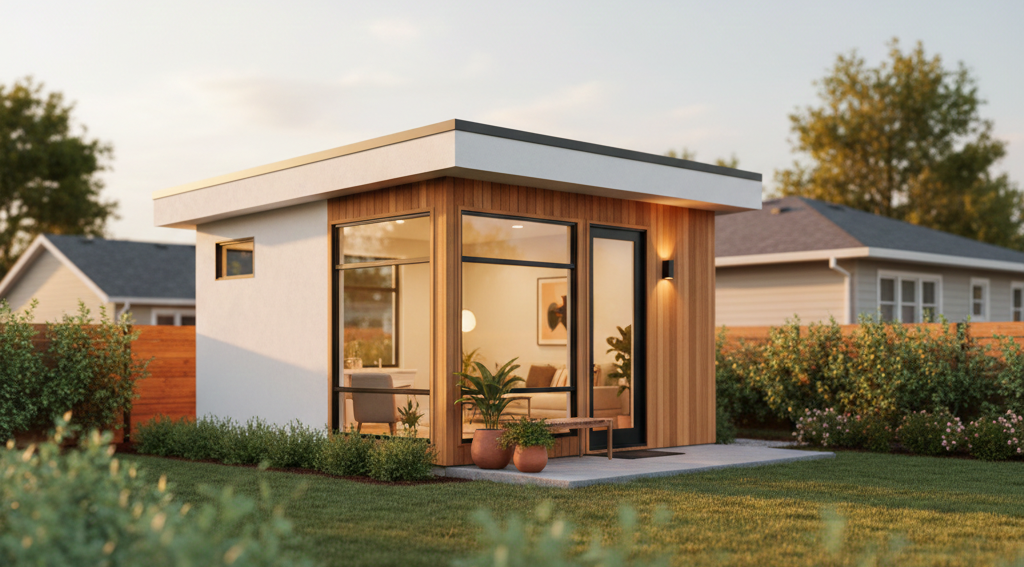
An Accessory Dwelling Unit is a secondary residential unit located on the same lot as a primary single-family home. It is a fully self-contained living space — with its own entrance, kitchen, bathroom, and sleeping area — that can be rented independently or used to house family members.
ADUs go by many names depending on the region and the specific format they take. You may have heard them referred to as granny flats, in-law suites, backyard cottages, carriage houses, casitas, or secondary suites. Regardless of the name, they all share the same fundamental characteristic: a separate, livable unit attached to or located on the same property as the primary home.
There are several distinct types of ADUs, each suited to different property configurations and budget levels.
A Detached ADU is a completely separate structure built on the same lot as the primary home — a standalone backyard cottage, a converted garage, or a purpose-built secondary dwelling. Detached ADUs offer the greatest privacy for both the homeowner and the tenant and typically command the highest rental rates.
An Attached ADU is an addition built onto the existing primary structure — an extension of the home that includes its own separate entrance and self-contained living facilities. This type is well-suited to properties with limited yard space.
A Garage Conversion ADU involves converting an existing attached or detached garage into a habitable living space. This is often the most cost-effective route to adding an ADU, since the basic structure already exists and the primary work involves interior build-out, insulation, plumbing, and electrical upgrades.
A Junior ADU (JADU) is a smaller unit created within the existing footprint of the primary home — typically converting a bedroom or internal space with a private entrance and a kitchenette. JADUs are the lowest-cost option and are subject to specific size limitations, usually capped at 500 square feet.
Why ADUs Are Having a Major Moment in 2026
The ADU landscape has transformed dramatically over the past several years, driven by a confluence of policy reform, housing market pressure, and shifting demographic needs — and 2026 finds this momentum stronger than ever.
Legislative Reform Has Opened the Door. Across the United States and in many countries globally, governments at state and local levels have been systematically removing the regulatory barriers that once made ADU construction difficult or impossible. California led the way with sweeping ADU reform legislation, and dozens of other states have followed with their own versions — streamlining permitting, reducing fees, eliminating owner-occupancy requirements, and mandating that local governments approve compliant ADU applications within defined timeframes.
In 2026, more jurisdictions than ever allow ADUs by right — meaning they can be built without discretionary approval or neighborhood opposition hearings. This regulatory clarity has given property owners and investors the confidence to move forward with ADU projects that would have been far more uncertain just a few years ago.
The Housing Shortage Is Not Going Away. The United States and many other developed nations are facing a structural housing shortage that has been decades in the making. Demand for housing — particularly for affordable, well-located rental units — far outstrips supply in most major and secondary markets. ADUs are increasingly recognized by policymakers, planners, and communities as a practical and scalable solution to this shortage, because they add housing supply without requiring new land, new infrastructure, or large-scale development.
This policy tailwind means that ADUs are not just tolerated — they are actively encouraged in many markets. And when policy supports an investment category, the long-term outlook for that asset becomes significantly stronger.
Rising Rents Maximize ADU Returns. In markets where rents have risen substantially over the past several years, the income potential of a well-placed ADU is genuinely compelling. A detached ADU in a desirable location can generate anywhere from $1,500 to over $3,500 per month in rental income depending on the market, the unit size, and whether it’s positioned as a long-term rental or a short-term furnished rental. For a property owner whose primary mortgage may be $2,000 to $3,000 per month, an ADU generating $2,000 in rental income transforms the financial dynamics of homeownership entirely.
Demographics Are Driving Demand. Multiple demographic trends are converging to fuel demand for ADU-style housing. Millennials and Gen Z renters value privacy and proximity to urban amenities over large square footage, making compact, well-designed ADUs highly attractive rental options. An aging Baby Boomer population is driving demand for multigenerational living arrangements — grandparents moving into a backyard cottage on their adult children’s property is a growing phenomenon. And the continued prevalence of remote work means that people need dedicated, separate workspace, which an ADU provides perfectly.
The Financial Case for ADUs in 2026
The numbers behind ADU investment are compelling when you examine them carefully.
Construction costs for ADUs vary widely depending on type, size, location, and market. A garage conversion might cost between $80,000 and $150,000. A purpose-built detached ADU can range from $150,000 to $350,000 or more in high-cost markets. These are meaningful investments — but the financial returns need to be evaluated against both rental income and property value appreciation.
Rental income generated by a well-located ADU can deliver a return on investment that rivals or exceeds most other real estate strategies on a per-dollar-invested basis. An ADU that costs $200,000 to build and generates $2,000 per month in rent produces $24,000 annually — a 12% gross return on the construction cost alone, before accounting for the fact that the underlying land was already owned.
Property value uplift is the other significant financial benefit. Studies and appraisals consistently show that a legal, well-constructed ADU increases the overall value of a property — often by more than the construction cost. A home with a permitted, income-generating ADU commands a premium in the resale market, both because buyers value the existing income stream and because they recognize the difficulty and cost of adding one themselves.
Financing options for ADU construction have also expanded in 2026. Cash-out refinances, home equity lines of credit, construction loans, and ADU-specific financing products are all available in most markets. Some states and municipalities even offer low-interest loan programs or grants to incentivize ADU construction as part of their housing supply strategy.
ADUs as a Wealth-Building Strategy for Existing Homeowners
For homeowners who have no current plans to buy an investment property, an ADU is one of the most accessible paths into real estate investing — because it leverages an asset you already own.
Rather than accumulating a down payment for a separate investment property, navigating a new purchase transaction, and managing a property across town, an ADU allows you to generate rental income from your existing lot. You remain on-site, which simplifies property management significantly. The capital required — while still substantial — is typically less than purchasing a second property outright in most markets. And the income generated can be deployed toward paying down your primary mortgage, funding future investments, or simply improving your household cash flow.
For many homeowners, an ADU is the bridge between owning a home and becoming a genuine real estate investor — a first step that builds confidence, generates income, and demonstrates the fundamentals of rental property management on the most familiar terrain possible.
ADUs as a Value-Add Strategy for Real Estate Investors
For established real estate investors, ADUs represent a powerful value-add opportunity. Acquiring a property with an existing permitted ADU provides immediate income diversification — two income streams from a single acquisition. Identifying undervalued properties with the physical and regulatory potential to add an ADU creates a clear path to forced appreciation and enhanced cash flow.
In competitive markets where finding good deals is increasingly difficult, properties with ADU potential — large lots, detached garages, underutilized floor plans — represent a niche that sophisticated investors are actively targeting. The investor who can see the ADU potential in a property that others overlook has a significant competitive advantage.
Key Considerations Before Building an ADU
While the opportunity is compelling, successful ADU investment requires careful planning and due diligence.
Zoning and permitting must be thoroughly researched before any project begins. While regulations have relaxed significantly in many areas, requirements still vary considerably by jurisdiction — regarding setbacks, maximum unit size, height limits, parking requirements, and utility connections. Confirm what is permitted in your specific municipality before committing to a project.
Design and construction quality matter enormously for both rental performance and resale value. An ADU that is poorly designed, cramped, or cheaply finished will underperform in the rental market and add less value to the property than one that is thoughtfully designed and well-executed. Work with an architect or ADU specialist who understands both livability and investment performance.
Tenant selection and management for an ADU requires particular care, especially for owner-occupants who will be living in close proximity to their tenant. Screen tenants rigorously, establish clear lease terms, and maintain professional landlord-tenant boundaries from the outset.
Tax implications should be understood before you proceed. Rental income from an ADU is taxable, but construction costs, depreciation, and operating expenses may be deductible. Consult a tax professional to understand how ADU income will interact with your overall tax situation.
Final Thoughts
The ADU is not a trend — it is a structural shift in how residential real estate is being developed, valued, and used. Driven by housing shortages, regulatory reform, demographic change, and the compelling financial returns they generate, ADUs have established themselves as one of the smartest and most accessible real estate investments available in 2026.
Whether you’re a homeowner looking to generate passive income from your existing property, a first-time investor seeking a lower-barrier entry into real estate, or an experienced investor hunting for the next value-add opportunity, ADUs deserve a prominent place in your investment thinking this year.
The opportunity is real, the timing is favorable, and the fundamentals are strong. The only question is whether you’ll act on it.
