



Introduction
Most people who want to build a real estate portfolio think they need a lot of capital. They save up for one down payment, buy one property, watch their capital tied up in that asset, and wait years before they can afford the next one. That pace — one property every several years — does not build meaningful wealth in any reasonable timeframe.
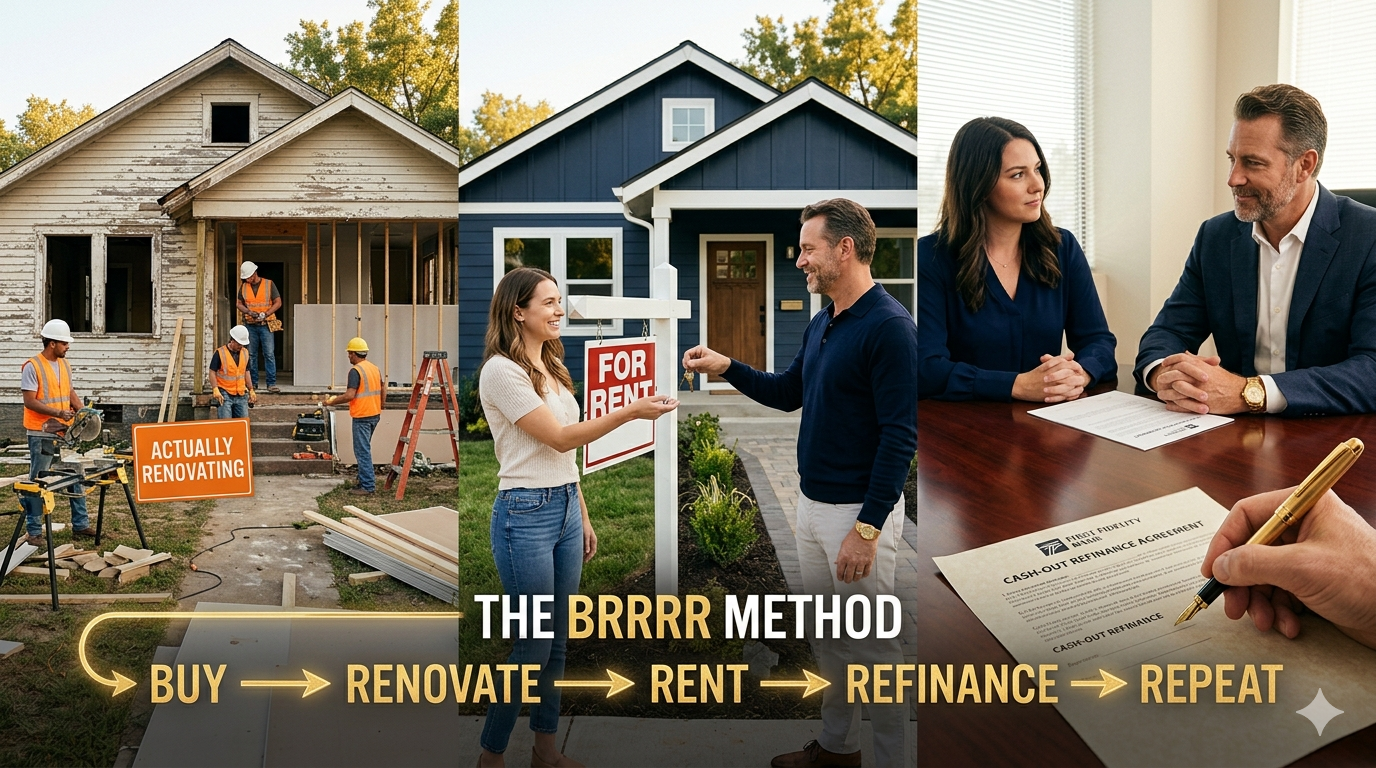
The BRRRR method changes the math entirely. It is the strategy that allows investors to recycle the same capital across multiple properties — buying distressed assets below market value, rehabbing them to force equity appreciation, renting them to generate cash flow, refinancing to pull the invested capital back out, and repeating the cycle with the same dollars on the next deal.
Done correctly, BRRRR is how investors build portfolios of five, ten, or twenty properties without proportionally scaling their initial capital investment. Done incorrectly — with poor acquisition pricing, cost overruns, weak rental markets, or aggressive refinance assumptions — it is how investors lose money and end up with overleveraged properties that produce no cash flow and trap capital rather than releasing it.
This blog is the direct, no-nonsense breakdown of every phase of the BRRRR method — what each step requires, where the risk lives in each phase, and what separates the investors who execute it successfully from those who learn its lessons the expensive way.
What BRRRR Stands For and Why the Cycle Matters
BRRRR is an acronym: Buy, Rehab, Rent, Refinance, Repeat.
Each letter represents a distinct phase of the investment cycle, and the power of the strategy lies in how these phases connect. The purchase is made at a discount specifically because the property requires rehabilitation. The rehabilitation creates value that did not exist at purchase — forcing appreciation through improvements rather than waiting for the market to deliver it. The rental establishes the income-producing asset that qualifies the property for refinancing. The refinance extracts the forced equity in cash, returning the investor’s initial capital. And the repeat deploys that returned capital into the next acquisition, beginning the cycle again.
The mathematical elegance of BRRRR is this: if executed at sufficient precision, the investor ends up owning a cash-flowing rental property with little to no capital remaining in the deal — because the refinance returned the original investment. The property is producing monthly income, building equity through mortgage paydown, and appreciating over time — all with effectively recycled capital rather than permanently deployed savings.
That is the theory. The execution requires precision at every phase, because the margin for error in BRRRR is tighter than most beginning investors appreciate.
Phase 1: Buy — The Deal That Makes Everything Else Possible
The entire BRRRR strategy succeeds or fails at the acquisition. Every subsequent phase — the rehab, the rental, the refinance — is constrained by the price paid at purchase. Buy at the wrong price and no amount of excellent execution in subsequent phases can rescue the deal.
The fundamental acquisition metric in BRRRR is the After Repair Value (ARV) — the estimated market value of the property after all planned renovations are complete. The purchase price and renovation budget combined must come in sufficiently below ARV to create the equity spread that makes the refinance work. The standard benchmark used by experienced BRRRR investors is the 70% rule: the total of purchase price plus renovation budget should not exceed 70% of ARV. This creates a 30% equity cushion that provides room for the refinance to return capital while leaving adequate equity in the property.
Finding properties that meet this criterion requires deliberate sourcing — not browsing retail MLS listings where properties are priced for owner-occupant buyers who do not require a 30% discount to transact. BRRRR properties come from distressed seller situations: foreclosures, probate sales, tax delinquencies, motivated sellers facing financial pressure, and off-market deals sourced through wholesalers, direct mail campaigns, or investor networks.
The other critical acquisition discipline is accurate ARV estimation. An ARV that is inflated — based on comparable sales from different neighborhoods, different property conditions, or different market cycles — produces a false picture of the equity available at the end of the cycle. Hire a local real estate agent or appraiser with direct knowledge of the specific submarket. Pull your own comparable sales analysis. Be conservative. The refinance will reveal the true ARV, and discovering it is lower than anticipated at that stage is an expensive lesson.
Phase 2: Rehab — Controlled Execution at a Known Cost
The rehabilitation phase is where most BRRRR deals succeed or fail operationally. Cost overruns are the number one killer of BRRRR returns — because every dollar over budget is a dollar that erodes the equity spread the acquisition was structured to create. A deal that penciled at 68% of ARV becomes a deal at 78% of ARV when the renovation runs 10% over budget, and the refinance math collapses entirely.
Before acquiring any BRRRR property, the renovation scope and cost must be estimated with precision. This is not a rough estimate. It is a line-item budget — every trade, every material category, every permit cost — developed with contractors who have seen the property and priced the specific scope of work. If you cannot get a reliable renovation estimate before closing, do not close. The uncertainty of an unestimated renovation is not a manageable risk in BRRRR — it is a deal-breaker waiting to happen.
The rehabilitation scope should be focused on value-adding improvements that justify their cost in ARV appreciation — kitchens, bathrooms, flooring, paint, curb appeal, and functional systems that lenders and appraisers will recognize as material improvements. Cosmetic-only renovations that do not improve functional condition produce lower ARV gains relative to their cost. Renovation scopes that exceed what comparable properties in the neighborhood support — over-improving for the market — produce no return on the excess investment.
Control the timeline. Every month the property sits in renovation is a month of carrying costs — financing, insurance, taxes, utilities — with no rental income to offset them. Delays compound cost. Set a realistic renovation timeline, manage the contractor relationship actively, and build a 10-15% contingency reserve for the unexpected discoveries that every renovation produces.
Phase 3: Rent — Establishing the Income That Qualifies the Refinance
The rental phase accomplishes two things simultaneously: it begins generating the cash flow that justifies the investment and establishes the income-producing status of the property that most lenders require before they will execute a cash-out refinance.
Most lenders who execute BRRRR-friendly refinances require the property to be rented and producing income for a seasoning period — typically three to six months — before they will proceed. This seasoning requirement is a critical timeline variable in BRRRR planning. The cycle does not complete in 90 days. Factor the seasoning period into the holding cost calculation from the beginning.
Rental pricing must be set at the market rate for the property’s condition, location, and bedroom count — not at the rate needed to make the deal cash flow at the investor’s target return. The market sets the rent. If the market rent for the property, after the refinanced mortgage payment and all operating expenses, does not produce positive cash flow, the deal structure needs to be re-evaluated — not the rent artificially inflated.
Tenant quality matters more than most beginning investors appreciate. A bad tenant in a BRRRR property — one who damages the property, pays late, or requires costly eviction — can consume months of rent in recovery costs and set the refinance timeline back significantly. Screen rigorously. Income verification, credit check, rental history, and reference checks are not optional.
Phase 4: Refinance — Pulling the Capital Out to Deploy Again
The refinance is the mechanical step that makes BRRRR a portfolio-building strategy rather than a single-property investment. It is the phase where the equity created through discounted acquisition and value-add renovation is converted back into liquid capital — returning the investor’s initial investment for deployment into the next deal.
The refinance is typically executed as a cash-out refinance or a Debt Service Coverage Ratio (DSCR) loan — a loan product specifically designed for investment properties that qualifies based on the property’s rental income rather than the investor’s personal income. DSCR loans are the preferred refinance vehicle for BRRRR investors because they are available regardless of the number of investment properties the investor owns, they do not count against conventional loan limits, and they can be executed with no seasoning requirement in some programs.
The refinance amount is typically 70-75% of the property’s appraised value. The appraisal is the moment of truth in the BRRRR cycle — where the ARV assumption that drove the acquisition decision is tested against a licensed appraiser’s independent assessment of market value. If the ARV was estimated accurately and the renovation was executed to the standard comparable properties support, the appraisal will confirm the expected value and the refinance will return the target capital. If the ARV was overestimated, the appraisal shortfall leaves capital trapped in the property.
The post-refinance position the deal should achieve: a rental property with a new mortgage at 70-75% LTV, positive monthly cash flow after all expenses including the new mortgage payment, and the investor’s initial capital substantially or fully returned for redeployment.
Phase 5: Repeat — The Cycle That Builds the Portfolio
The fifth phase is not a step — it is a mindset. BRRRR is not a one-time strategy. It is a repeatable system, and the investors who build meaningful portfolios through it are the ones who treat each completed cycle as the funded acquisition of the next one.
With capital returned from the first refinance, the investor returns to the acquisition market — sourcing the next distressed property that meets the 70% rule, executing the renovation with the experience and contractor relationships built in the first deal, and cycling through the phases again. Each successful cycle builds the investor’s competency, their contractor network, their lender relationships, and their portfolio — with the same initial capital doing more work with each iteration.
The portfolio compounds. Three BRRRR cycles with the same $80,000 initial capital — if executed with discipline — can produce three income-generating properties, three appreciating assets, and three mortgage-paydown vehicles, all from an investment that would otherwise have funded one conventional rental purchase. That is the wealth-building potential of the BRRRR cycle executed correctly.
The Risks That Kill BRRRR Deals
BRRRR is not a strategy for the underprepared. Every phase carries specific risks that can eliminate the deal’s returns if they are not anticipated and managed.
Overpaying at acquisition is the most unrecoverable error. If the purchase price is too high relative to ARV, the equity spread that makes the refinance work does not exist — and nothing in the subsequent phases can create it retroactively.
Renovation cost overruns eat the equity that acquisition was designed to create. A 10% cost overrun on a $60,000 renovation scope is $6,000 in additional capital that never comes back in the refinance. A 25% overrun on that same scope is the difference between a successful cycle and a deal that traps capital.
Appraisal shortfalls occur when the appraised value at refinance comes in below the ARV that was assumed at acquisition. This is the single most common point of failure in BRRRR — and it is prevented by conservative ARV estimation, market-appropriate renovation scope, and working with appraisers who are familiar with the specific submarket.
Vacancy and carrying costs during extended rehab timelines or prolonged lease-up periods consume returns and delay the refinance. Time is not neutral in BRRRR — it costs money. Budget carrying costs for the full expected timeline plus a reasonable buffer.
Aggressive refinance assumptions — expecting 75% LTV at a high ARV — leave no margin for appraisal variance. Conservative refinance projections with 70% LTV and conservative ARV assumptions produce realistic return expectations and protect against the scenario where the numbers do not come in exactly as modeled.
How TLNTB Partners Fits Into the BRRRR Strategy
The BRRRR method, executed correctly, requires capital, contractor relationships, lender relationships, market knowledge, and project management capability working together at every phase of the cycle. For investors without all of these elements in place, the learning curve is expensive — and the deals that go wrong during the learning process are the ones that cost the most.
TLNTB Partners provides the co-ownership structure that gives investors access to BRRRR-type deals — fix-and-flip and value-add acquisitions across 25+ states — with the professional infrastructure already in place. The deal sourcing, the renovation management, the contractor network, the financing relationships through The Lender NTB, and the exit strategy execution are handled by a team with 100+ completed projects and $50M+ in managed capital.
Partners participate in the returns — targeting 15-25% — with the knowledge that every phase of the deal is being managed by professionals who have executed this process at scale. The risk of the amateur BRRRR cycle — the overpriced acquisition, the cost overrun, the appraisal shortfall — is substantially mitigated by the experience and systems that TLNTB brings to every deal.
For investors who want the BRRRR-type returns without building the full infrastructure required to execute independently, co-ownership with TLNTB Partners is the accelerated path.
Final Thoughts
The BRRRR method is one of the most powerful portfolio-building strategies in real estate investing. It is also one of the most demanding — requiring precision at acquisition, discipline in renovation, patience through seasoning, and accuracy in refinance assumptions. The investors who master it build portfolios and wealth at a pace that conventional buy-and-hold investing cannot match.
Get the acquisition right. Control the renovation. Price the rent at market. Be conservative with the refinance. And treat every completed cycle as the funding mechanism for the next one.
That discipline, applied consistently over years, is how real estate portfolios are built.
To explore how TLNTB Partners’ co-ownership model delivers BRRRR-type returns with professional execution, visit tlntbpartners.com or call +1 888-532-1279.
